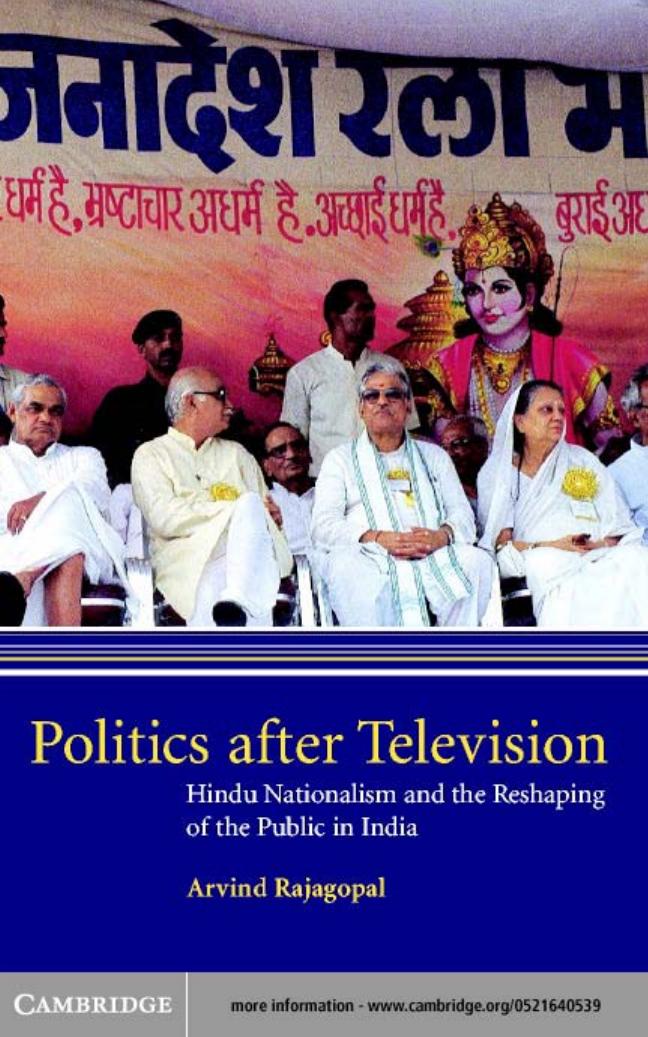
Politics after Television: Hindu Nationalism and the Reshaping of the Public in India by Arvind Rajagopal
Author:Arvind Rajagopal [Rajagopal, Arvind]
Language: eng
Format: epub, pdf
Published: 2008-08-13T16:39:00+00:00
LANGUAGE-DIVIDED PRINT MEDIA AS A STRATEGIC RESOURCE
This chapter has examined the Ram Janmabhumi campaign from the outside as it were, in terms of the reportage of the series of maneuvers carried out at Ayodhya, their repercussions in the capital, and the ways in which these reflected the stances of the press. A discursive shift occurred in the late Ig8os, I have argued, as Hindutva became an overarching framework for thinking about economy, polity, and society together. It was not the only one available, but offered itself as the most powerful alternative to the effect Nehruvianism had exercised on the political imagination. This chapter has considered the initial phases of that shift, and marks its partial and turbulent character. The reconfiguration of the relationship between the vernacular and the language of command, reflected in the confusion and alarm of the English language press, was one way of indexing the realignment of political forces, and the emergence of a new language of politics and a new rhetoric of political mobilization. The Ram Janmabhumi movement was itself predominantly a Hindi language movement, but one that showed the influence of leaders who developed their strategies with a multilingual society in mind. The task of understanding such a movement dramatized the social distance between English and Hindi language presses, and showed that their respective codes of interpretation did not mesh with each other and had scarcely attempted to do so in the past.
Coverage of the Janmabhumi movement was marked by a sense of cultural intimacy on the part of the Hindi language press, as opposed to the perspective exhibited in the English language press, which on the whole viewed the movement as a threat to peace and stability. A belief in the transparency of political power underlay the English language press's conception of itself as capable of speaking on behalf of the nation at large. Neither its colonial nor its post-Independence experience permitted the Hindi language press to share quite the same assumption. A popular religious nationalist movement challenged the English language media's complacency about its own cultural centrality. Underlying this complacency was an assumption of the propriety of the cultural order imposed by the state, and an acceptance of state authority as the leading developmental agency. The Ram Janmabhumi movement spoke in many voices, but among other things it asserted the right to kill, rendering unmistakable its challenge to the state's monopoly on violence, and underwriting its claim to state power. If various sections of the press, English and Hindi language both, had reservations about this last claim, it is the distance that the English language press maintained from popular exhortations to political mobilization, and the relative closeness of sections of the Hindi language press to such mobilizational rhetoric that must be highlighted.
What was critical was that English language news values were statecentric, following a colonial heritage, and reflecting the perspective of an elite business class that depended on the patronage of the developmentalist state. As such, English language news tended to require a certain distance from indigenous culture as a way of asserting its authority.
Download
Politics after Television: Hindu Nationalism and the Reshaping of the Public in India by Arvind Rajagopal.pdf
This site does not store any files on its server. We only index and link to content provided by other sites. Please contact the content providers to delete copyright contents if any and email us, we'll remove relevant links or contents immediately.
| Anthropology | Archaeology |
| Philosophy | Politics & Government |
| Social Sciences | Sociology |
| Women's Studies |
The Secret History by Donna Tartt(19294)
The Social Justice Warrior Handbook by Lisa De Pasquale(12224)
Thirteen Reasons Why by Jay Asher(8996)
This Is How You Lose Her by Junot Diaz(6955)
Weapons of Math Destruction by Cathy O'Neil(6363)
Zero to One by Peter Thiel(5864)
Beartown by Fredrik Backman(5839)
The Myth of the Strong Leader by Archie Brown(5552)
The Fire Next Time by James Baldwin(5503)
How Democracies Die by Steven Levitsky & Daniel Ziblatt(5271)
Promise Me, Dad by Joe Biden(5189)
Stone's Rules by Roger Stone(5130)
A Higher Loyalty: Truth, Lies, and Leadership by James Comey(5017)
100 Deadly Skills by Clint Emerson(4972)
Rise and Kill First by Ronen Bergman(4838)
Secrecy World by Jake Bernstein(4798)
The David Icke Guide to the Global Conspiracy (and how to end it) by David Icke(4771)
The Farm by Tom Rob Smith(4550)
The Doomsday Machine by Daniel Ellsberg(4545)
